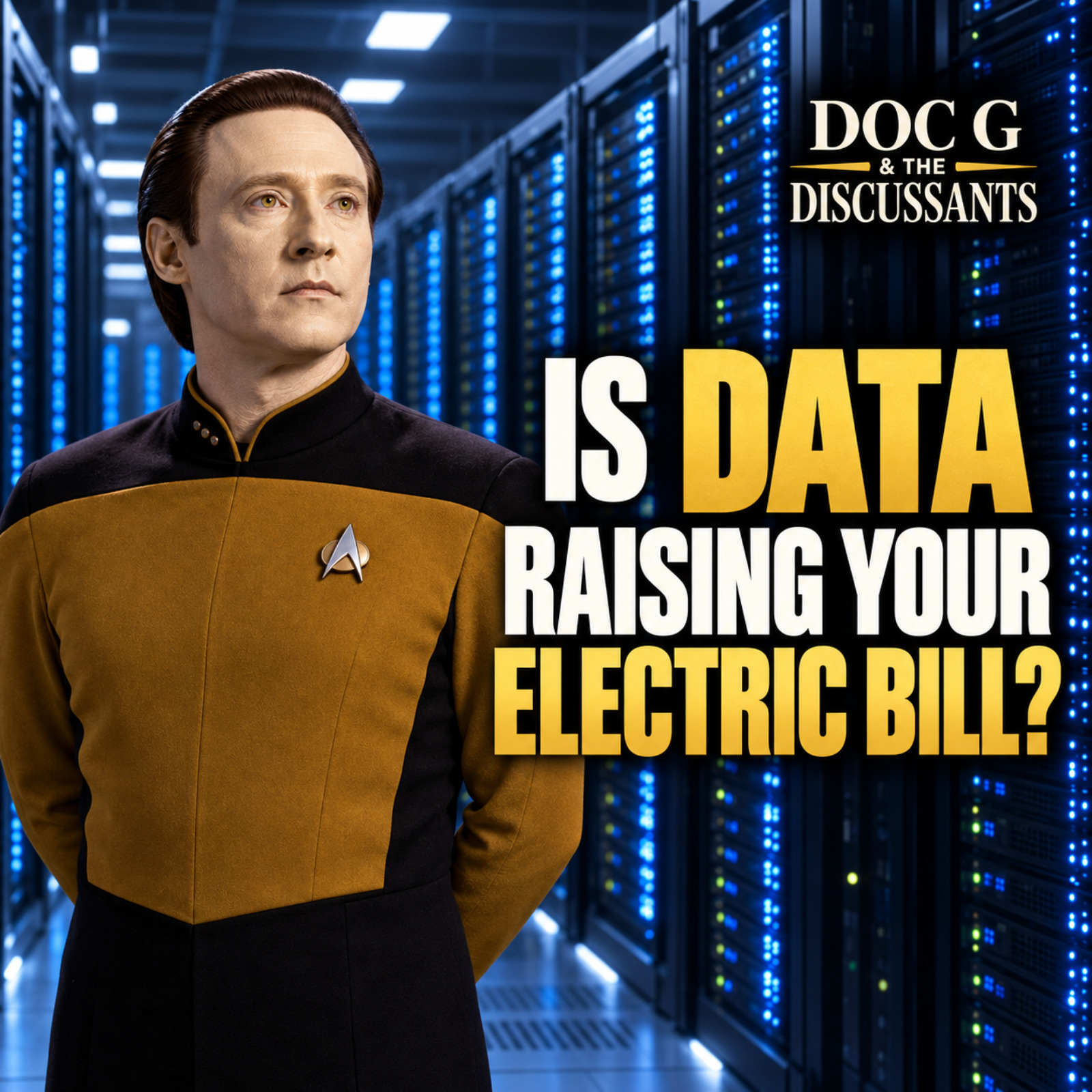
Is Data Raising Your Electric Bill? The Hidden Cost of America's AI Data Centers.
This Episode
AI data centers are consuming rapidly growing amounts of American electricity and water—but does that growth have to raise your utility bills? Doc G and the Discussants follow the money from artificial-intelligence servers to new power plants, transmission lines, water systems, utility rates and PJM capacity costs. They examine Big Tech tax incentives, jobs, water consumption and rules that could make data centers pay their own way while protecting households and grid reliability.
The Hidden Cost of America’s AI Data-Centers
Attention! Here is today's trigger warning. If you require a warning before hearing an opinion, consider yourself now warned. Because somewhere in the next hour, someone may ask what you believe, what you believe it, and whether you had anything resembling evidence. Those easily offended by facts, follow -up questions, or complete sentences, they wish to leave right now. those remaining can meet the cast and suggest subjects that deserve our attention by visiting us at .gandthediscussance .com. You're listening to .gandthediscussance on sabbatical.
The Doctor is in. Well, you're not unlike anybody else out there. So welcome in. I wanted to remind everybody that we've got a big week of shows coming up. This one today is about AI data centers or just data centers. And we're going to sort of run down what the hidden costs of America's AI data center boom might be to the individual. This is something that I sort of, I don't know, poopod as this is the left deciding that, you know, we don't need power centers, those sorts of things. The more I did research on it, the more I thought, you know, my bet is there's a lot of people out there that are sort of feeling that way, like I'd like to know a little bit more.
Well, we're going to do that for you today. On Wednesday, we're going to talk about underage gambling. Underage gambling? Well, yeah, with these with these new laws that it's expanded where you can gamble from anywhere. Right. From your phone, from, you know, your room late at night under your covers, those sorts of things. There's a lot of kids start to gamble. And I've sort of wanted us to be on the record as saying. And this is something that's coming that I think people need to be aware of because I think, you know, a lot of kids end up sort of ruined anymore before they even get started right under their parents' noses, right under the noses of their teacher.
They're sitting there. They could, you know, look like they're just playing with their phone while they're losing a fortune on all these gambling apps. And it's not just sports. You can bet on anything now. You can bet on, you know, election outcomes, those sorts of things. Have you seen Junior's gray? Yeah. Have you seen his seen our bank account after Junior decided to hijack our credit card and go to Draft Kings or wherever he's going to go with it? So I thought that would be interesting. And then we have the second part of the Ozark Music Festival, where the professor has been we have to go back there again.
Yeah, because we got to finish it up. We only did we only did like two. Sodom and Gomorrah, that's such a dangerous place. Yeah, and it's actually titled Sodom and Gomorrah. Sodom and Gomorrah in Missouri, the Ozark music festival and the untold story there. And there's really no one who lived that any more fully than the professor. He was there with a camera the entire time. He flew over the festival. He himself, those guys that were those guys that were partaking in the prostitution buses may have lived it to a little heavier extent than I did.
Yeah. So there were actual prostitution buses at this thing. And so, you know, for us and just to, I don't know, not to put too fine a point on this. You know, they're talking about in different parts of the research here where, you know, everybody in Sedalia continues to talk about this. I've never found that to be the case. You know, I've never found that to be the case. And as you know, I've just not heard that much talk about it after it was over with it seemed like is more of a big secret that we just don't talk about around here instead of sweep that under the rug and pretend it never happened.
Does that does it seem that way to you as well? Yeah, yeah, yeah, and so you know I think it's a story that you know the rest of the nation really doesn't know that much about but this thing was likely bigger than wind stock had some outstanding bands and it had some real Sodom and Gomorrah type atmosphere for real and that's the part we're going to get into Friday So you'll want to make sure that you stay close this week because we have some really great things coming up Make sure that you subscribe so you never miss.
Otherwise, it's easy to miss, and that way it just comes to you. Also, the website. Part of the reason why the website was... So Made so easy to follow was so you didn't have to go to any platform to get the show You can go to the website hit one button. It'll say listen now You can go to the latest episodes or all the episodes. You don't have to go to any other website You don't have to go to a podcast hosting service. You can go straight to us on our website Which is more fun anyway, because you can write to us.
You can tell us what you think of the show you can write to the professor and tell him, hey man, I really dig what you said about the festival and will you send me a couple pictures of yourself with Ted Nugent? He might just be able to - Well, I didn't get that close. I got close to Ted Nugent many years before that at a concert in a little town where they wanted him to stop playing at this big ball field and he wouldn't stop until they shut his electricity off and he was out in the crowd, we were all there in the dark, Ted was mingling with all the people, all of his fans.
He was with the Amboy Dukes, and Ted was just cussing up a storm, but yeah, it was within 24 inches. It was exciting. There was magic in the air, but that was a long time ago. I can imagine that, you know, if you're within 24 inches of Nugent, that there would be a must in the air, you know, in aroma for certain. Swing, dang, swing, dang! So that's getting back to things that are on people's mind that are a more little certainly more Serious than that What we're going to attempt to do with this data center thing is to follow the money from an AI prompt to a household power bill and decide whether the company's creating the demand or paying the full cost of serving it.
Now there's a lot of people who don't think so. Artificial intelligence feels weightless. You type in a question and an answer appears, but behind that answer are buildings. There's a lot of these buildings. When you hear a lot of buildings, until you know the scale of the actual construction that's going on out there. For example, in Texas, there's 300 of these things under construction right this second. And they are huge. They are the size of car plants and even bigger than that. And they are huge places, packed with computers that consume electricity every second.
The technology may be revolutionary, but the bill is already becoming political. I thought I would play this from PBS so you could get an idea of the scale of what's going on. It's estimated that by the year 2030, companies will have invested nearly $7 trillion in data center infrastructure in a race to dominate the AI market. But this race to build AI superiority is happening so fast, many are concerned that companies might be cutting corners or taking advantage of regulatory loopholes. especially when it comes to the electricity and water required to run these massive data centers.
Your AI query likely pings a data center like this, full of millions of power -hungry processing chips running the chatbots, agents, and other tools that millions of people interact with every day. But to power those operations, data centers around the country are increasingly relying on their own custom -built gas power plants. The Stargate data center already has 62 diesel generators and 10 gas -powered turbines on site, with plans for 41 more. This will make it one of the largest fossil fuel power plants of any kind in Texas.
And it's just to power this data center. It has a, you still have a gas turbine engine? Yes, I do, I do. I actually have one out of my shop. It's waiting until I get back to my aircraft project that I started. That thing's a little scary. I started this project in I guess 19, middle of the mid 80s, maybe 85 -ish. And then I abandoned it two years later or at least put it on the back burner where it's been ever since when I was forced to. That's my bird in the background by the way green Amazon parrot he's part of this podcast, but anyway I had to leave the project for a while because we were ousted from our living quarters because a church nearby was going to turn our Property into a parking lot.
So I guess it was uh, I'm not gonna say it certainly wasn't heavenly domain and that's another another podcast. It was just a church's business. I think so that's Anyway, the project was put on hold at that point and then life got in the way so to speak the new residents need a lot of work so my gas turbine powered aircraft is on hold It's waiting till I get back to it. I've heard a couple stories about the power of that engine now I've seen it. It's really not very big, but it is plenty scary It's got your attention a couple of times hasn't it?
Oh yeah, I ran it on a test stand a few times and it always scared me when I ran it. I think if I went back to the project, I wouldn't be so freaked out as I was back then. That was kind of my introduction to it back in that era. Now I kind of know what to expect, but I was so frightened of it that I even put a shield on the test stand between me and the engine itself and an instrument panel on my side to run the thing. I don't know, I guess I was just paranoid. I stepped into an area I knew nothing about and it was frightening.
I think I'm probably over that if I can return to the project. I'm not going to need to. a shield between me and the engine. So what's going on in these AI power center or these data centers is they've got these huge gas turbine engines mounted on trucks. So it's loud. Yeah. And part of the reason why they do that is so they can say they're just temporary. They are not the actual infrastructure. And these are huge gas turbine engines and they run them because they have to have them to power these things.
These ones that are in Texas that you were talking about, are they like next to communities? Are they out in the middle of nowhere? Some communities have embraced them because of the tax revenue that they bring because of the jobs that they're supposedly going to bring. Some of them are sort of out in the middle of nowhere. Right. So both things are going on. The only jobs that they have technically that will stay there are the construction jobs, right? Well, after those, that's a point that's coming up.
So they've promised a lot of jobs, but after these things are actually built, it doesn't take that many people to mine the computers that are inside. It depends on how big this is. Exactly. So there's a lot of jobs to start with, and there are jobs that are left because these places are huge. But in terms of comparing it to like an automobile plant, They're not going to stay. Right, not as many of those sorts of jobs. So the Department of Energy's 2024 national report says data centers used about 4 .4 percent of U .S.
electricity in 2023, and they could use 6 .7 to 12 percent by 2028, roughly double or triple their 2023 consumptions. When we come back, The computers do not receive a separate electric universe. They enter the same grid that serves your refrigerator and the cost can travel all the way to your meter. You're listening to Doc G and the Discussants. The discussion continues in just a moment. While we take a break, go to Doc G and the Discussants dot com. Meet the Discussants. Catch another episode.
Support the show, visit the shop, or tell your favorite cast member exactly what's on your mind. Doc G and the Discussants on sabbatical, back after this. Every successful show has great sponsors. If you'd like to introduce your business to our audience, we'd like you to consider our tremendous sponsorship opportunities. Choose from general admission, mezzanine, front row floor, backstage pass, or executive producer. Every sponsorship includes recognition on the show. founding sponsor status, preferred advertising rates, and additional benefits based on your sponsorship level.
You'll find complete details at dgnd .com or docgandthediscussance .com. or simply looking for a better place to manage your everyday finances, our local team is here to help. With convenient online and mobile banking, competitive lending options, and people you can actually talk to, Ozark Regional Bank combines modern banking with hometown service. Stop by one of our convenient locations or learn more today. Ozark Regional Bank. Local people. Local decisions. Member FDIC Equal Housing Lender.
Security isn't about reacting. It's about knowing. Deep Blue Home Security gives you full visibility, doors, windows, motion, all of it, where you need it. Quiet system, immediate alerts, and no unnecessary noise unless that noise matters. Deep blue home security. You don't think about it because it's already handled. Insurance has become complicated enough. Heritage Mutual Group believes coverage should still come with real conversations, straightforward answers, and people you can actually reach when something goes wrong.
Whether it's home, auto, business, or life insurance, Heritage Mutual Group works to help protect what matters most without the runaround. This message is for Shana, my mom who just finished her high school diploma. I wanted to say I'm so proud of you for finishing school. You told me it's never too late to achieve your dreams. I hope to make you as proud as you have made me. When you graduate, they graduate. Finish your high school diploma for you and for them. Visit finishyourdiploma .org to find free and supportive adult education centers near you.
Brought to you by the Dollar General Literacy Foundation and the Ad Council.
How Data Centers Can Raise Your Electric Bill
At the intersection of policy, politics, and culture, you're on sabbatical with Doc G and the Discussants. To contact the program or email your favorite discussant, write to docgshowstudio at gmail .com. We are talking about AI data centers as are most of the nation, one way or another. Several Republican governors, a lot of Democratic governors, but several Republican governors, including Governor Abbott down in Texas, have sort of put the brakes on this a little bit. Looking at it a little bit more seriously, because I think that they are starting to become aware of just what the demands are going to be.
You know, this new demand is going to create a need for generation, transmission and guaranteed capacity. Regulators then decide who's going to pay for all this. So more load can require new power plants, substations and transmissions. Utilities cover approved cost and through rates. Regional capacity markets also pay generators to be available when demand peaks. Just to give you some idea, this is as big as the defense budget. New facilities like this are being built largely to meet demand for generative AI tools like chatbots.
OpenAI reported that global use of chatbots more than doubled in the last year, going from 400 to 900 million users. Big tech companies are projected to spend more than $800 billion on the infrastructure behind artificial intelligence in 2026. And in 2027, that number will exceed a trillion dollars. That's on par with the entire U .S. defense budget.
Stargate is one of the most ambitious and powerful AI data centers ever built. The proposed on -site power plant could deliver more than 1 .7 gigawatts of power. That's enough energy to power more than 1 million homes for a year. The Stargate facility is in Texas and it is massive. In the nation's largest regional grid, PJM's independent market monitor says data center growth is the primary reason for recent and expected capacity market pressure. One 2026 analysis attributed 6 .5 billion or 40 percent of the capacity cost to data center load.
So, you know, that brings up some questions. A data center does not automatically raise every energy bill. New large customers can spread fixed costs and improve grid utilization. But bills rise usually when their added infrastructure and risk are shifted to existing customers. rather than charge to the companies creating them. And this is something that Congress is now starting to look at because if they were like myself, I did and have heard and have been... concerned mildly that these were going to impose a lot more usage which could increase electricity bills while electricity bills are going up anyway.
I know, you know, personal electricity bills have crept up over especially the last couple of years, but If this is going to increase by double and triple and it's already consuming huge amounts of power, I don't think that any of us should be surprised if the bills increase. Now, there are fail saves where the government and local governments, especially state governments, making some of these outfits. provide their own infrastructure. And President Trump has talked about making these data centers provide their own electricity.
Well, what happens when President Trump is no longer around or the Republicans are not in power? And here's another question. What happens if they start building and they just decide to quit and they pull out after they've? done a lot of work on these huge data centers, and they decide, hey, we've built some of this infrastructure, but we're not going to finish it anymore. How do you make sure that this thing doesn't really impact people in a bad way? And so the more I got into this question, the more I could see why even conservative governors who really pushed this, for good reasons because you know they're worried about national competitiveness state competitiveness those sorts of things why they're taking a second look why all of a sudden do we need so many i mean is it because everything is now using it you've got your smart phones you've got your refrigerator that's a smart refrigerator your whole house is a smart house i mean everything so is that why we need them or because of the all the ai generated um both It's both.
So they were building these data centers to begin with. Gaming is a big deal, where people that are gaming are taking a lot of computing power, and it takes big data centers to run those things, and the networks and social media, those sorts of things. They were already building these centers. Then along comes AI, and it is power. It is eating everything up at this point. And thus, the talk of little nuclear reactors for these things, like aircraft carriers and submarines run a bridge too far for a lot of people.
You know, they remember some fairly serious accidents that happened not all too many years ago. Look at all the blood that's been shed to get to the point where we are now with the airliners, for example. I mean, thousands of deaths and crashes every time we learn something from each one. I don't know how much of that we're going to have to go through with data centers and nuclear reactors and all that. A nuclear reactor is probably a good idea if it's small and we've gotten to the point that it'll stay contained and we can depend upon it to become a reliable piece of equipment.
I don't know anything about it. I hope that's the case. Nuclear sounds good if it works properly, but, yeah, we do have a history of frightening events in that area. Back to you, Doc. Yeah, the problem here is that once there's a nuclear accident, It's not like an oil spill. You know, people pull their hair out over an oil spill. A nuclear accident is sort of forever in some ways. You know, it seems like I've seen, we've seen some... documentaries lately on Chernobyl and what has happened around there.
And it seems like it's doing better than a lot of people expected, but at the same time the radiation levels there are super high. Same thing with some recent accident in Japan. In the last 10 years a Fukushima plant blew up, really blew up. I mean worse in most ways than Chernobyl. meltdown. So, you know, having a whole lot of these little bitty nuclear reactors out there and they're run by companies who maybe are or are not all that financially viable, then they're supplying the personnel to make sure that these things are safe.
There's questions there for certain, but the alternative is what they're doing right now. So when they come in, a lot of times they'll say they're going to have this be sustainable. And by sustainable, they then mean nuclear, which is scary. So what they do is they bring in all these gas powered, diesel powered generators, these gas turbine engines. And there might be a hundred of these things to supply the power that they need, which is a lot of power. But they usually don't get approved with that.
because of people's concerns around fossil fuel burning and the amount of fossil fuel that will take. So it seems like maybe this technology has maybe outgrown itself a little bit. And to chase it down, sort of like Professor suggested just a little bit ago, there's always a learning curve. And in previous generations, years gone by in America, You know, that usually costs lives or, you know, in one way or another, and I'm not so sure that he isn't right about this and that this may cost some lives in this circumstance as well.
I'm not sure I'm comfortable with that. Well, it's worth it. We've got to keep the gamers electrified. That's sort of how it seems and But at the same time I'm also hearing well, you know AI is such an essential technology to America going forward And I sort of believe that so Then on top of it. We're hearing reports and from some fairly credible people including Elon Musk that this is a technology that people are going to have to watch very carefully because more than one person has said it could be the end of a human being.
So Trump, Trump called it the new oil industry. We'll get back to the president. Isn't that what he said? It's the new oil industry? I'm not sure how I feel about... Well, I mean, how do they make money with this, I guess? When we come back, we'll explore some of these questions. When we take a look at... The industry says these projects create investment jobs and tax revenue, but states... are also competing to give them tax breaks. So what exactly are taxpayers buying? You're listening to Doc G and the discussants.
You're on sabbatical.
Before we continue, perhaps you'd like to circle back, unpack the conversation, sit with it, process it. and make sure everybody feels heard? Or you could simply decide whether it makes any sense, bit radical I know. This is Doc G and the Discussance. The truth is more interesting than fiction and far more valuable than cliches or talking points. We'll be back. The people around this table have a lot in common. They're all accomplished and interesting. They've spent their lives behind microphones, built businesses, taught students, designed and built remarkable machines, made music -led organizations, solved problems, and entertained audiences for years.
They're talented, experienced, and every one of them are people you want to know. That's what makes them Discussants. Meet the people behind the microphones at docgandthediscussants .com Plumbing and electrical to outdoor equipment and seasonal supplies, Mill Creek Hardware believes customer service still matters. Mill Creek Hardware. Built for people who still like doing things themselves. You bought the stuff. You wanted the stuff. And now you have absolutely nowhere to put the stuff. That's where green lawn storage comes in.
Clean units, easy access, plenty of room for furniture, tools, boxes, and everything else you swear you're going to use again someday. Green lawn storage. Your stuff needs a home too.
Markets change. Economies change. Your long -term strategy shouldn't depend on panic and guesswork. Sterling Ridge Financial provides retirement planning, investment guidance and personalized financial strategies designed around your goals and your future. Sterling Ridge Financial, steady planning for uncertain times. So by stopping at the education section of a resume, you might throw away the perfect hire. You might miss someone who has valuable skills to offer, to help your business thrive right now and in the future.
Because the truth is this. Skills First Hiring helps you see talent others miss. Like more than 70 million stars, skilled through alternative routes. When you let their story unfold, you gain a competitive advantage. Because hiring managers who start with skills are 60 % more likely to find a successful hire. See the real person. Complete. See what others miss. Hire skills first. Learn why it's a competitive advantage at tearthepaperceiling .org. Brought to you by Opportunity at Work and the Ad Council.
If you
Tax Breaks, Jobs and the Public Price
have need for an emotional support animal, well, you're in the wrong place. You're on sabbatical with Doc G and the Discussants at the intersection of policy, politics, and culture. Have a question for your favorite discussant? Well, please visit us on the World Wide Web at thediscusses .com. The Doctor is in. Thank you very much. We're back and we're talking about AI data centers or data centers in general that we can't this is a Huge huge topic. This is the kind of thing. I was working in the legislature that would just consume an entire session.
Right. It would. I can see that. Yeah. I mean, just writing the bills and to think of all the things could happen. And then you got, you know, lobbying forces on all sides, trying to make sure that the whatever legislation comes out of it is suitable. This would be one of those things where it'd be night after night after night after night after amendment, replacement bill, substitute, those sorts of things. to go on and on and on and it should because this is extremely complicated and you know high stakes.
You know, to test the economic development pitch against the public price, tax incentives and permanent jobs, water consumption, that's something we'll talk about here in a minute, and the possibility, and I think a pretty good possibility of higher water bills and electric bills if it isn't controlled fairly closely. Data centers bring enormous capital investment, construction work, technology infrastructure, and potentially durable local tax revenue. but they can also support the national race for AI leadership at the same time, which everybody has agreed is an important thing, and especially for the next generation of military hardware.
In the subsidy race, the National Conference of State Legislatures, which it did a lot of work with, reports that at least 38 states offer data center incentives. So come and settle in our state. We're going to give you these tax breaks, tax exemptions, relief on electricity taxes, and in 11 states some form of property tax relief. It kind of defeats the purpose, doesn't it? Exactly, and that's what we're getting at. The multi -billion dollar server campus is not a billion dollar factory. It may employ large construction crews, but permanent staffing is often modest relative to the investment and public concessions.
The right comparison is total public cost per lasting job and per dollar of new revenue that would be generated in that. You know, it's sort of hard to look in a crystal ball and project that. That's where the lobbyists come in. They say, these are all the jobs that's going to be created and it's a workforce development idea and it's going to help your state lead the nation in AI technology and what? A politician doesn't want to go home and say that he's helping to do that or her. Well, back to your workforce development.
Once the place is built and it's up and running, you're talking about, what, 30, 50 people? Oh, I think we're talking about a whole lot more than that, but not the same amount of people that, you know, it takes. These things are huge. I mean, we're talking about buildings that would cover all of Central Park in New York City. huge a complex I mean you can't do that with 30 40 people they're just going to have to have more than that but it's not the same thing as a whole building full of people who are building cars it's just not this not comparable in the number of people and there's a lot less people needed to build cars these days a lot of computers or a lot of robots and computers are doing that as well so let's just talk about what it means to us I mean these are great big questions but what does it mean to you know us How about in terms of water uses, this from PBS."
The tens of thousands of high -powered chips inside a data center like this generate enormous amounts of heat, requiring massive cooling systems to prevent failures. Stargate uses a closed -loop cooling system that circulates water to pull heat away from the machines. While these systems usually only need to be filled once, they do require more electricity to run. By some estimates, the rise in data centers in the state of Texas could increase water usage a whopping 9 % by the year 2030. It's estimated by Berkeley Labs that the U .S.
data centers directly consume 66 billion liters, about 17 .4 billion gallons of water in 2023. Direct consumption could rise to roughly 38 to 73 billion gallons, billion gallons. It's hard to wrap your head around how. big a number, billions are, power generation adds as much larger indirect water footprint. So we're not just talking about electricity. We are talking about a lot of water needed to use it as well. So now, how does that reach your bill? How does that impact your water bill? Well, high local demand can force a utility to expand wells, treatment, storage, and pipelines if the data center does not cover those system -specific costs.
and existing businesses can face higher water rates. The effect is local and depends on cooling technology, the technology used to actually cool, the water source available capacity and the contract. Let me say this while we're here in terms of cooling. The Norwegian countries, Finland, some of these countries that stay cold, they're getting a lot of data centers built because they're cold. and to make sure that they can cool without the need for some of these things. So it's a boon, at least at this point, to colder climates.
and places where the politics will allow it to happen. Do we have any? Why are we not building them in Alaska? That's what I just was asking. Yeah, I think that I don't. That's a good question. I don't know the level of activity that's going on in Alaska underwater. But my bet would be that you've got all the good ideas. Yeah, my bet would be that. Alaska is getting a lot of interest to build. But you know, there's a lot of federal land in Alaska, too, which could be tricky. But I would say that this is a target for certain.
Underwater, that's sort of like living on Mars. The professor could tell us about what it's like to live and work underwater. He's a scuba diver. Right. It would be hard to work on if something needed fixed on. You'd have to, you know... bring it back up or go down. Doesn't mean it couldn't be done if it was done where it was sort of self -contained. Just brainstorm it and design it for that location so there'll be no surprises. Just take everything into consideration and then send the crews out to put it together.
Yeah I think that but these are these are important questions right this second and they're under construction you know I mean there's 300 of them now in Texas currently under construction and the answer right now is gas turbine engines diesel turbine engines and the neighbors in these areas are not happy because of the noise. They're saying that they're saying there's a lot of particulates in the air that you know they didn't bargain for when they bought their property having trouble maybe selling their property afterwards so you know this this clean thing that has been sold to legislatures to begin with about we're going to use nuclear we're going to use you know renewable sources That's really kind of not happening now.
They're promising it down the line. What they're calling this is we start small. You start small. You start with a smaller thing. You promise what you have to promise to get the permits and then off you go with whatever it takes to build them.
Went into this little project and boy, you know, there's a lot to know about this But I went in this little project as being skeptical I think well, you know here we go again people getting all worked up about what's gonna end up to be nothing These things are huge and they must they must be built in order to satisfy the requirement for people to Have the things that they wish to have at that point. That's quite a bit or is this the next calm bubble? Well, I don't know about that. I mean, I think AI is here to stay for certain.
I mean, and here's something else. It might make itself stay around. You know, we might figure out a way to stay around one way or another. You know, at this point, you have to really watch AI to use it. Because it really doesn't think like you do. but it can do things quickly. It wasn't very long ago there was a report from the battlefront in Ukraine where the Russians used one of these and they just let it go on its own AI generated targeting and it killed what it wanted to kill without any intervention from people whatsoever.
I think that's probably a lot more of that going on than anybody's going to say but you know a Russian Anything that comes from Russian, built by Russians, and then it's going to make decisions about who it's going to kill, bothers me. You know, they sort of build junk, and have built junk forever. And anytime we meet Russian hardware on the battlefield, it ends up in... in the trash heap, they have to sell it. There's countries that can't buy our stuff, they're not in our orbit, so they buy from the Soviets, they buy from the Chinese, and then we quickly dispatch it for them.
But that may not always be the case, if you steal this technology, which I hear that the Chinese are really busy trying to do, and you can't blame them. If you think you're a step behind, you better find a way to get in front of this. We have people that'll give it to them. Unfortunately, that seems to be the case. We'll come back and when we do, America does not have to choose between AI leadership and affordable electricity. The real choice is whether government writes rules before the bill arrives or whether it writes them after.
You're listening to Doc G and the Discussance. The discussion continues in just a moment. While we take a break, go to docgandthediscussants .com. Meet the Discussants, catch another episode, support the show, visit the shop, or tell your favorite cast member exactly what's on your mind. Doc G and the Discussants on sabbatical, back after this. If you're looking for the official Doc G and the Discussants merchandise, you'll find it on our website, DGND .com. Browse our sabbatical collection for premium tees, hoodies, signature women's v -necks, whiskey rocks glasses, distressed ball caps, coffee mugs, and more.
Everything in the store is something we are proud to own ourselves. Take a look at DocchiPodcast .com or DocchiAndTheDiscussance .com That's enough. Maplehouse coffee. Good coffee. No meeting required.
At Oak and Iron Home Center, quality still matters. From premium mattresses and living room furniture to dining sets and home accents, Oak and Iron focuses on comfort, durability, and timeless design without the pressure and confusion of the big box stores. Visit Oak and Iron Home Center and see the difference for yourself. Don't you wish your life came with a warning app? Just a little heads up before something bad happens So you can have more control Well life doesn't always give you time to change the outcome But pre -diabetes does.
With early diagnosis and a few healthy changes, like managing your weight, getting active, stopping smoking, and eating healthier, you can stop pre -diabetes before it leads to type 2 diabetes. It's easy to learn your risk. Take the one -minute test today at doihabprediabetes .org. Warning. The cap is loose on that catam. Don't wait. You have the power to change the outcome. Visit do I have prediabetes .org today. That's do I have prediabetes .org brought to you by the ad council and its prediabetes awareness partners.
For example, when we say,
Who Should Pay for the AI Power Race?
at the end of the day, it's getting dark outside. Now, here's Donkey. As I've said before, he's a pet peeve of mine. Seems like every time I tune into a news broadcast of any kind, somebody's - Well, at the end of the day, then he's got himself. Every gosh - darn time, I've got somebody saying at the end of the day, like, find something else to say, just anything to say, you know, when all is said and done, how about that? You know, I don't like that. I don't really like that either. That's a cliche as well.
But at the end of the day, I just can't think anything. Or when we finish with this process, this is what you should look. Why not? There's, there's some people who can't go to sentences without saying that or... Well, at the end of the day, I mean, whatever. Of course, then we get all the help that we need from the professor with the pet peeve. Well, at the end of the day. So, let me again, before we get too far into this segment, join us next time for... the gambling show, which is something we sort of wanted to go on the record with.
I think that this is going to creep up quickly and surprise a lot of families. I think they're going to get surprised. They're already going to be surprised. with what's going on. So hang around for that. And then the professor is going to finish up with the Ozark Music Festival that we started last Friday. I'm really looking forward to that because we've got some rock and roll man rock and roll on a Friday. Yeah. What we're doing here isn't easy and it's not a whole lot of fun. I thought that this might be helpful to people because I didn't really understand the scale of this thing before I really got into it.
I thought, you know, I think there's some people out there trying to scare people with this, and that may in fact be going on, but these are big. And they consume a ton of power. And there's really kind of no end in sight. I mean, this is the start of it. This is the infancy of it. And we're talking about building a lot of these data centers. So a new data center can support. or contract for new generation. I mean, it can support its own generation or contract for new. Storage and demand flexibility as well.
During grid emergencies, large loads can curtail or run approved backup resources instead of forcing households to observe every shortage. Absorb is what I should say, not observe. But who's going to absorb it? When you've got a business that's contributing this much to the tax base, providing this many jobs. They've done a lot of lobbying in state houses and at the federal level. If they need more electricity, are we supposed to leave? They're not going to get it and that they're not going to take it out of my grid, which is down about, you know, I'm starting to wonder if I'm living in a third world nation anyway, sometimes around here.
We've been out without power. It seems like all it takes is a decent rainstorm and I'm out of power Now I'm I'm headed out to start up the old generator and run some you know Electricity or some cords through the house to plug in our essential stuff So now I've got a Dana sitter next to me and if they want the power am I supposed to? Expect that I'm going to that mine's gonna be untouched Unless the rules are made correctly, I think that even if they are, I expect that there's going to be some problems.
Tell me, man, you're going third world. You are going third world. It sort of seems like it. I never used to have this sort of problem with my electricity before. And not to speaking of that, I sort of want to finish thoughts here. Not too long ago, I had to call and I actually had to contact my senator just to get my mail delivered. Right. Yeah. I mean, in the United States of America that, you know, It originated these sorts of services nationwide. I think the Pony Express was actually better at getting people their mail than mine was getting to me.
I couldn't believe it. I had to complain, I don't know how many times, to the local office. And finally, they said, hey, I guess we'll go over your head. Well, boy did I ever. And it got straightened out fairly quick. I haven't really had a problem for a while, but that's what it took. to get the mail. You remember in the dark of night, they're supposed to deliver it through blizzards and all this kind of, I couldn't get it on a regular day at noon. It was always in somebody else's box. It never made it to mine.
That's a whole other show. It's a problem. Congress is wrestling with the mail and people not getting their mail for a variety of reasons, including it being stolen, problems at the post office, those sorts of things. So the question here is should existing customers, should they pay for this speculative demand? The company requesting electric and water service, should they bear the cost and risk of facilities built specifically for it, unless a regulator can demonstrate a durable public benefit?
You know, on the other side, I don't think that we should pretend that there's no, you know, upside. New customers can strengthen a utility system and lower average costs when contracts are enforceable, assets are useful, and the customers stay. you know stays around to use it so you know there's there's positives and minuses here but I thought that it's something that people need to know about and they need to think about and they need to do their own research about because it's coming. And we're talking about the very early stages of this.
Now, one thing that I've noticed over the years is that a lot of times technology fixes its own problems. What was once a problem in heat and with needing a lot of power can then sort of go away when we get better technology. So technology poses problems, it also fixes them. Well, that'll be all worked out. Ultimately, in the meanwhile, the citizenry be damned. Well, I kind of think that's part of the reason why some really conservative legislators and governors are starting to worry because they pushed it.
They really pushed it. They wanted it. They wanted it. They wanted it. And I think they're seeing that this could cause us a huge political problem in fairly short order, unless things are really well taken care of. And when you say well taken care of, well taken care of, that is so far fetched that if it weren't tragic, it would be laughable. Well taken care of. Yeah, I think so too. I'm trying to be a touch optimistic here, but It's like I said a little earlier do I really believe that I'm not going to be affected if one of these colossal if these colossal thing moves next door to me I expect I will be and I expect that it won't be in any good way so There are roughly 300 data centers here in Texas with at least a hundred currently under construction with an additional hundred more planned and the vast majority are powered by fossil fuels.
Texas has around 80 gigawatts of natural gas power under construction, and roughly half of those plants will provide power exclusively to data centers, without even connecting to Texas' electrical grid. Some of these approved sites are massive. One approved site in West Texas is slated to generate nearly 8 gigawatts alone, making it the largest proposed data center in the country. That 8 gigawatts is roughly enough to provide electricity for more than half the homes in the state, but that power will be off the grid, solely for one data center.
While this so -called behind -the -meter strategy can reduce strain on the grid and might keep electricity prices down for consumers, it also means more power plants emitting more harmful pollutants across the state. The companies building these data centers almost always promise that they'll use renewables or nuclear when they announce their projects. But when you look at the data, most of what's actually being built right now is powered entirely by natural gas. It will be at least 2028 before renewables power AI at any real scale and new nuclear plants are a decade or more away.
So a decade away even though there's at least 300 of them being built in just Texas. So I really hope that this helps. our audience to understand the scale of what's going on out there. It just depressed me. It's a frustrating thing. I feel worse than before the show. Yeah, we didn't even talk about the water usage. Well, we did. A little bit. Yeah, a little bit, but not not to the degree that it can happen. So but I thought it was something everybody's talking about. It can't walk by a television without some sort of report about, you know, data centers and This is us trying to give you a little heads up about maybe what you should start your own research.
Think about these things for yourself and maybe forecast what you can do about it. Don't forget, on Wednesday it's going to be a gambling show. We've got a lot of young people that are starting to take on a lot of debt because of gambling. You're listening to Doc G and the Discusses. This program is finished. The argument certainly is not. There are more episodes to hear, more ideas to challenge, and more opportunities to tell us exactly what you think. Visit docg and the discussants dot com. Meet the gang, leave a comment, suggest a show, drop something into Doc's gripe box, support the program, check out the sponsorship opportunities, and while you're there, you may as well visit the shop.
docg and the discussants .com. We'll see you next time.
 Apple Podcasts
 Castbox
 Castro
 Goodpods
 Moon FM
 Overcast
 Pocket Casts
 Podbean
 Podcast Addict
 Podcast Republic
 Spotify